|
Egypt
Information
|
||||||||
|
||||||||
|
The area of the Arab Republic of Egypt is more than 1,000,000 km˛. Its borders stretch from the Mediterranean in the North , where the Nile meets the sea, to the borders of Sudan , Libya and over the Sinai Peninsula to the borders of Israel and by sea, Jordan and Saudi Arabia. The Nile ( the world's longest river with its 6,600 km ) has created through tens of thousands of years, a fantastic fertile landscape on its banks where approximately 95 % of Egypt's
|
||||||||
|
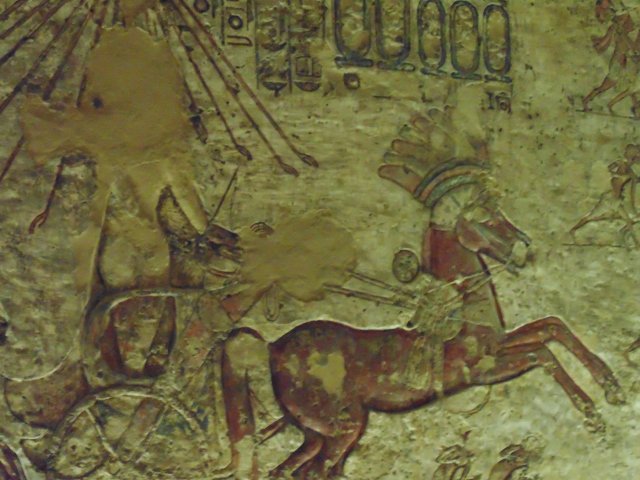
the oldest in the world , but it is of course the pharaonic era that made Egypt famous and unique. Egypt , or Kemet as it was called in pharaonic time, was unified around 3000 B.C. Old Kingdom, or the Pyramid Age, lasted from 2650 - 2200 B.C. , and during this period most of the country's 90 pyramids were built. During the Middle Kingdom (2000 - 1700 B.C.) an emporium was started being built stretching from South Sudan to Iraq and further. This colonization caused an invasion from the east by the Hyksos, which ruled Egypt from 1700-1550 B.C. leaving behind the introduced horse and carriage that Egyptians learned to master.
The pharaohs of the New Kingdom, 1550 - 1000 B.C. ruled from Luxor in the south where you can find their exquisite tombs in the Valley of the Kings and the " Pharaonic " Vatican, The Temple of Karnak.
In 332 B.C. Alexander the Great came to
Egypt starting the Greek Ptolemaic Era . The Romans and later Byzantium took over after winning the battle of Actium in 30 B.C. Later on, Cleopatra VII committed suicide - using snakebite, which lead the holy family to flee to Egypt. St Marc came to Christianize the Egyptians, leaving behind him one of the first Christian communities in the world; the Coptic Church. In 642 A.D. the Arabs overruled Egypt. During the coming hundredsof years Cairo and Egypt was alternately controlled from Damascus, Baghdad and from different clans like the Tulun family, the Fatimides, the Ayoub family and the Mamelouks. By 1517, Egypt became a part of the Ottoman Empire until the invasion of Napoleon in 1798.
From 1805 begins modern Egyptian history under the reign of the Mohamed Ali family. Cotton was starting to be cultivated; railroads and the Suez Canal were built, modernization had struck Egypt.
In 1952 Farouk the last king of Egypt, was overthrown in the revolution led by Gamal Abd El Nasser. By coming to Egypt, you will hear more about Cheops, Ramses, Saladin, Nefertiti,
Sadat and Amon
personalities!
|
||||||||
|
Egypt
has a long summer, from mid - march until the beginning of December with temperatures during daytime between 25° and 40° C. Day time temperatures during winter varies between 15 and 28 degrees. At nights, temperatures sink very fast, in the winter sometimes under 10°. Temperatures in Upper Egypt (south) are usually 5°C higher than Cairo and the rest of the north of Egypt.
|
||||||||
|
During summer you need light clothes. In winter, a coat or jacket will be needed in the evening. Comfortable shoes are a must. In the city centers, in mosques and churches clothes that are more conservative should be worn.
|
||||||||
|
Arabic is the Official Language, while English and French are widely spoken by educated classes.
|
||||||||
|
The Egyptian pound (LE) is the official currency. One LE consists of 100 piasters. Bills of the Egyptian pounds are of 1, 5, 10, 20, 50, and 100 pounds value and 25 and 50 piasters One US dollar equals approximately LE 4.5 (Dec. 2001). There are banks in all 5* star hotels, as well as in the city centers (many of which are open 24-hours a day).
|
||||||||
|
The population of approximately 68 million people is concentrated along the Nile, on 5% of Egypt's total area. 16 million people live in Cairo and its suburbs. Other large cities are Alexandria, Mansoura, Tanta, Zagazig, Ismailia, Suez, Port Said, Aswan and Luxor.
|
||||||||
|
Around 85% are Muslims and approximately 15% are Coptic Christians.
|
||||||||
|
The voltage is always 220 V in all tourist establishments. |
||||||||
|
of bread
and drink too much water with their meals. loaves.
Inrural areas, bread is made of unloavened maize flour. meals. In the average Egyptian home breakfast is substantial meal consisting of more than one of the following items. (Cored Beef ), Halawa (Sweet Sesame Cake), Jam (Meraba) or honey (Assal Abyad) and tea
(Shai) or Coffee (Qahwa). flour pie, served with either sour cheese or
honey). to individual customs. However, dinner is normally a light meal, especially in summer time when it's customary to have for dinner white soft cheese.
Local Dishes:
and fried in oil. Foul is baked Faba beans, dressed with oil and lemon juice or served with butter and fried eggs. ( This may be linked in popularity to the hot American hot dogs and hamburgers).
Vermicelli, Macaroni and served with fried onions, chickpeas and hot Paprika sauce.
accompanies Kabab.
oven in the Tagen ( A clay pot ). Especially in country side.
( Marrow ) and green peppers, or vine leaves, all stuffed with rice, sometimes with minced meat, parsley and spices. It is very tasty and agrees with all tastes.
meat and pine kernels.
( recommended to be tried with lemon juice and paprika added ).
chicken broth and resembling a green soup, it's highly seasoned with spices and garlic and may only appeal to people with oriental taste.
kernels, nuts and raisins, it is usually served with turkey or chicken cut lets.
Egypt enjoys a wide variety of sea food. Fish is extremely good and among the most popular kinds are Bouri (Mullet), Morgan (red snapper), Arous (bass), SamakMousa (sole), Bolti (tylapia), Denees, Mias and Sardines, belong to the blue fish family, and are in great demand when in season.
The main local fish dishes are Samak Makli (fried fish), and Samak Mashwi (grilled fish).
and served with rice.
fritters, grilled or with curry are Creole sauce.
shaped blocks.
Egyptian cuisine has a variety of salads to offer.
amongst which one should not miss “gargir” ( winter cress) which has a delicate taste.
or without grabi and spices. It blends very well with kabab and grilled pigeons.
Together with European pastries, the Egyptian cuisine offers variety of oriental deserts, most of which are soaked in sugar syrup after baking and usually served with cream, and nuts added.
various forms.
or in rolls stuffed with pistachios and nuts.
with sugar, nuts and raisins being added.
or cheese.
the latter.
Fruits : Nearly all kinds of fruits are available. Drinks : Include a wide variety of fruit juices and carbonated beverages.
Egyptian coffee is served in demitasse and is made of very finely ground coffee, boiled in a brass pot (kanakah) until a forth develops on top.
It may be served without sugar (saddah), or with a little sugar (sokkar khafif), with a medium of sugar (mazbot), or with a lot of sugar (sokkar ziyadah).
But for now, tea (shai) is more popular in Egypt than coffee, and served hot with milk (shai bel-laban), or without milk (shai sadah), or with ment (shai-bel-neinnaa’).
We hope that this piece of information touches your anxiety to know more about Egypt, until we meet in the next seiry to reveal new secret of Egypt the land of immortality, we remain. |
||||||||
|
Diving in The Red sea & Sinai
Egypt
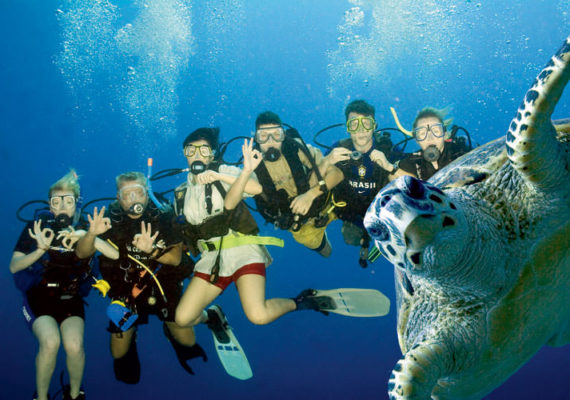
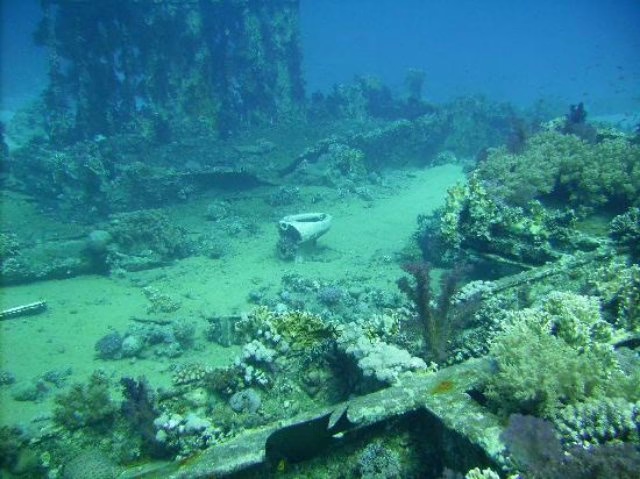
is not only the land of the Pharaohs i.e is also a country, where you can have more than the cultural guided tours, you can have too adventure ones ( diving & desert safari ) . The Red Sea is considered as one of three most famous diving spots in the world. While Sinai is one of the most important religious lands in the world; It was Sinai the chosen place from which prophet Moses received the ten Commandments, and it was the site on which one of the most famous monasteries in the world was built [the monastery of Saint Catherine].
Location of the Red Sea: See the Map of the Red Sea. Location of Sinai: See the Map of the Peninsula. (But Sinai has been divided from the main land of Egypt after the opening of the Suez Canal by K.Ismail in 1869 AD.)
Main Diving Centers of the Red Sea
Hurghada
By air: 3 - 4 Flights daily from Cairo. (1 hour flight.)By car: 5 hours drive from Cairo. (Through a well paved road) 2 hours drive fromLuxor. (Through a well paved road) ( Hurghada was the first developed area in Egypt as diving sport ) ( from Hurghada you can drive 1.30 h to Al-Gouna. (Recommended) (( From Hurghada you can drive 1.30 h to AL- Quseir.(recommended)
Sharm El Sheikh
By air: 3 flights daily from Cairo. (1 hour flight ).By car: 7 hours drive from Cairo. [through a well paved road.](Also possible to drive from Israel.)) (( Sharm EL Sheikh is one of the best diving centers in the world, it was the place many years ago the famous M.J. Costeau admired and took movie there. (From Sharm El-Sheikh you are recommended to drive to Ras- Mohamed , to discover the beauty of this exceptional place.) (( From Sharm El-Sheikh you are recommended to drive to Dahab),[1.30h drive to the North])) ((From Sharm El-Sheikh you are recommended to drive to Nuibaa [1.30h drive North of DAHAB]))
Water Temperatures (Average)
From December to February: 20-22 C.
From March to May: 22-24 C.From June to September: 22-27 CFrom October to November: 22-24 C.N.B: ( Diving is possible all year round, but the best season is from April to October.)
Diving Facility: there are many Diving Centers, all are well equipped.
(( better to bring your own diving suit.)) Diving Licence: It's easy to have through Diving Courses ((special lessons )) [for beginners]. (If you already have it, you're kindly asked to bring it.) Accommodation : Everything is available (from very cheap plain tents up to Deluxe 05 stars hotels.)
|
||||||||
|
Historical Essay The Egyptian Mysteries
Egypt has one
of the greatest & oldest civilization in the world, and certainly the most long lived, lasting for more than 3000 years. The ancient Egyptian civilization domination the eastern Mediterranean, at a time when Europe, America and most of western Asia were still in the stone age, and only came to an end with the conquest of Alexander the great in 332 B.C.
It has left a rich record of its history in the architecture, literature and art that have survived to modern times. One of the main cause of the remarkable homogeneity and continuity of the ancient civilization lies in the special physical characteristics of
the country.
Egypt consists mainly of two chains of low, mostly arid plateaus flanking the Nile valley. The plateaus known respectively as the eastern and western deserts, cover some 95% of the country's 1,002,000 Sq KM (625,128 Sq miles). The Nile river flowing between the escarpments of the eastern and western deserts, creates a thin band of cultivatable land from Aswan to Cairo and beyond Cairo the Nile branches out to create the Fan-shaped delta region, the heartland of the country's agriculture.
"Egypt is the gift of the Nile"
Thus said Herodotus, father of history 2400 years ago. The major unified factor in Egypt's economic and political life throughout its history, has been the Nile. That Egypt owes its existing and preservation as a civilized country to the river Nile, which, year after year since time immemorial, flooded the land along its banks. In doing so it also deposited annually a fertile legacy of rich silt which made possible a luxuriant vegetation and abundance in the midst of bareness. In fact, the Nile can be said to have created lower Egypt (the fan-shaped) delta at the north, building up layer upon layer of soil over geological aeons. Long before men began to investigate scientifically their environment, the Nile provided not only sustenance but also food for thought.
Throughout the years of antiquity, the settlements, found along the Nile thrived on the agriculture possibilities offered by its waters.
Great cities aroused like (Memphis) and (Thebes), which became in their times the capitals of the Pharaohs, later in history, came (Alexandria) and then the modern 1,000 year-old capital (Cairo). As mentioned before the Nile has always been a unifying force in Egyptian history, providing, as it does, a link between the ancient two lands of upper and lower Egypt ( respectively the southern and northern parts of Egypt). For over 5,000 years, boats carried foodstuffs and a variety of trade goods between the cities of the Nile. During the annual flood the Nile could also be used to bring building stones and sculptures from the quarries overlooking the Nile to the very limits of the inundated area, explaining how some of the greatest and most massive monuments of antiquity could be built so far from a source of large rocks. And as the Nile was the father of the ancient Egyptian civilization, the two deserts of Egypt were their mother, their great extension, helped by somehow in the prevention of the major foreign invasions to the Nile valley, which could threaten the stability and security of the green fertile valley, thus Egypt, enjoyed throughout its history a racially unmixed original population, as well as a sort of ancient universal security.
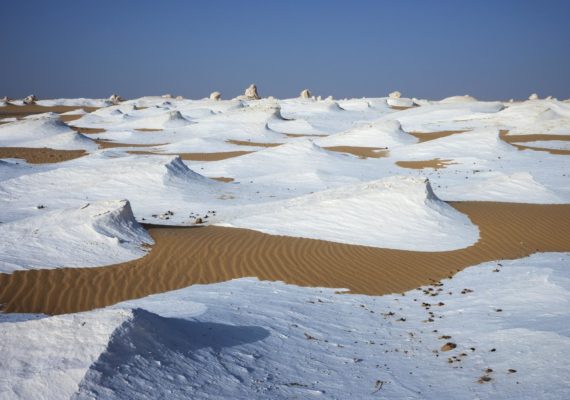
In the western desert, where sand dunes, rock strewn tracts and barren hills produce an almost lunar landscape.
Several oases such as (El Kharga), (El Dakhla), and (El Baharia), have been inhabited since the beginning of history. In the eastern desert and Sinai peninsula there are few wells and no oases, but the mountains terrain is rich in minerals, including hard building rocks, semi-precious stones, gold and copper.
Taking advantage of these resources, the ancient Egyptians were along the first in the world to develop the art of cutting stones and mining and smelting metals. The impression of the ancient Egyptians of the clarity and stability of the Egyptian environment gave in turn stability & clarity to their cultural & social traditions which in turn simplified their art lines compared to ancient arts in the world. On the other hand it has been reflected on their beliefs, that their gods for them believed to be more merciful than being merciless, as well as the profound belief in an afterlife whereas they would enjoy the best they did enjoy on earth. Egypt's position in the northeastern corner of the African continent has enabled it to act as a bridge between the Islamic and African worlds. To the north of Egypt is the Mediterranean sea. To the east is the red sea. Both of the two seas gave the country a very important role in the trade between Europe and Asia. The Sinai Peninsula in the N.E. of Egypt used by several invaders entering Egypt from the Levant, was divided from the mainland of Egypt by the Suez canal.
The opening of the Suez canal in 1869 enhanced Egypt's strategic advantage for Europe as the new route to India it afforded was shorter and avoided the navigational hazards of the cape of the good hope.
The border between Egypt and Israel in Sinai is based on the 1906 agreement between Egypt and Turkey delimiting the formers territory in Sinai. The current (1981) border between Egypt and Israel was scheduled to be adjusted under the terms of the peace treaty between the two corners, Israel was to return territory seized during the 1967 Arab-Israeli war. The Sinai and its offshore areas (particularly the Gulf of Suez) contain most of Egypt's oil deposits. The Peninsula's mineral resources are scheduled to come under full exploitation once Egypt regains full control of the region in 1982. To the south, beyond Aswan lie the cataracts. Successive rapids where the rocky formations infringe on the river and the Sudan. Egypt's southern border with Sudan was fixed by the1899 Anglo-Egyptian condominium. Flowing between Egypt's southern and northern borders is the Nile (The major unifying factor in Egypt's economic and political life throughout its history). The Nile is one of many rivers to rise in equatorial Africa but the only one to traverse northern Africa. It travels over 4.000 miles and finds an outlet in the Mediterranean sea. In its transit of Egypt the Nile converts what would otherwise have been a desert into a rich agricultural area. One that has supported not only the Egyptians but in later times the populations of Rome and Constantinople, as well as Mecca, Medina and other cities of the middle east. To the west Egypt shares a border with Libya. This was fixed in 1925 by an agreement between Egypt and Italy which was in control of Libya.
|
||||||||